Case Study
Learn at Your Own Pace
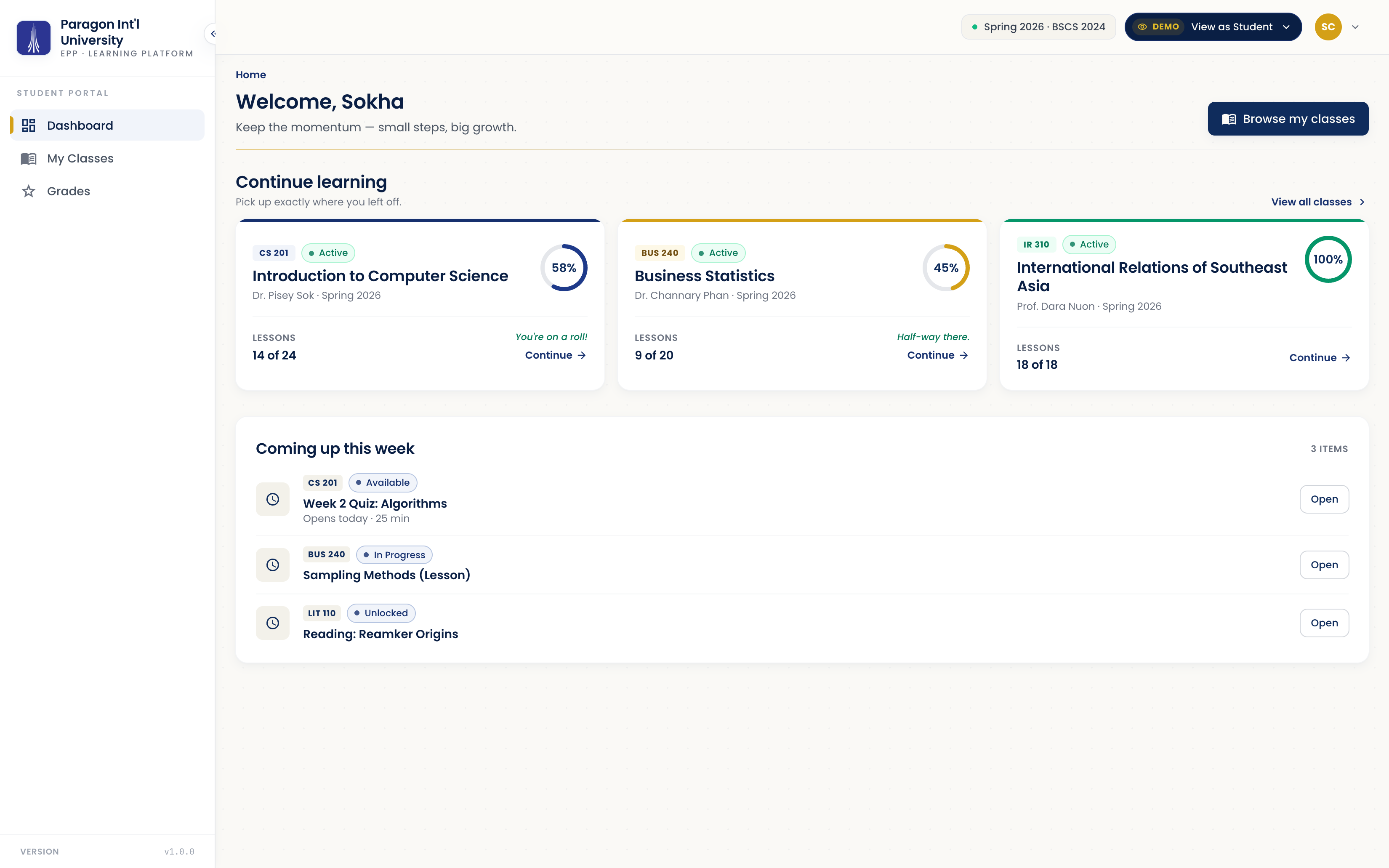
A microservice-based learning management system built for Paragon International University's English Preparatory Program, giving lecturers full control over content delivery and students flexible progression.
2025 - 2026
Agile Scrum, 4 Sprints
Project Manager, Team of 10
GoNext.jsPostgreSQLRedisRabbitMQKongFastAPI
mylms.paragoniu.app
How It Works
Learning Pipeline
1
Director Onboards
Bulk-uploads students and lecturers via CSV, triggering automatic invite emails
2
Lecturer Builds Content
Structures lessons and assessments, choosing self-paced or scheduled delivery
3
Student Progresses
Works through lessons behind an assessment-wall that unlocks material on mastery
4
Dashboards Report
Director and lecturer dashboards track individual and class-wide progress live
Capabilities
Features
Role-based Access Control (RBAC)
CSV Bulk Onboarding with Auto-Invites
Self-Paced or Lecturer-Controlled Progression
Assessment-Wall Progress Gating
Multi-Tier Progress Dashboards
Observability & Configuration Panel
Cloudflare R2 Lesson Material Storage
Google OAuth Sign-In
Code Sample
RBAC Middleware
middleware/rbac.go
// RBAC middleware enforced via Open Policy Agent
func RequireRole() gin.HandlerFunc {
  return func(c *gin.Context) {
    claims, ok := c.Get("jwt_claims")
    if !ok {
      c.AbortWithStatusJSON(401, gin.H{"error": "unauthenticated"})
      return
    }

    user := claims.(*auth.Claims)
    allowed := opa.Evaluate(user.Role, c.FullPath(), c.Request.Method)

    if !allowed {
      c.AbortWithStatusJSON(403, gin.H{"error": "forbidden"})
      return
    }

    c.Next()
  }
}
Technical Deep Dive
Challenges & Solutions
Flexible Progression Control
Problem
Google Classroom couldn't support an assessment-wall or mixed self-paced and lecturer-controlled progression
Solution
Designed a configurable progression engine so lecturers toggle between self-paced and scheduled delivery per class
Cross-Team Coordination
Problem
Coordinating 10 engineers across frontend, backend, API, UI/UX, and DevOps under a fixed 2-month, budget-capped timeline
Solution
Ran 2-week Agile Scrum sprints with clear service ownership and a single source of truth maintained with the tech lead
Service-to-Service Consistency
Problem
Keeping independent Go microservices and their own databases in sync without tight coupling
Solution
Adopted an event-driven architecture with RabbitMQ and Redis caching, so services react to events instead of polling each other
Architecture
System Overview
Next.js Frontend
Role-specific panels for director, lecturer, and student, built with Next.js and Tailwind CSS, calling the API through Kong.
Kong API Gateway
Validates JWTs, enforces coarse RBAC, and rate-limits traffic before routing REST requests to backend services.
Go Microservices
Independent user, course, assessment, and grading services communicating over gRPC, each backed by its own PostgreSQL database.
Observability & Config
OpenTelemetry collects logs, metrics, and traces into Loki, Prometheus, and OpenSearch for live troubleshooting.